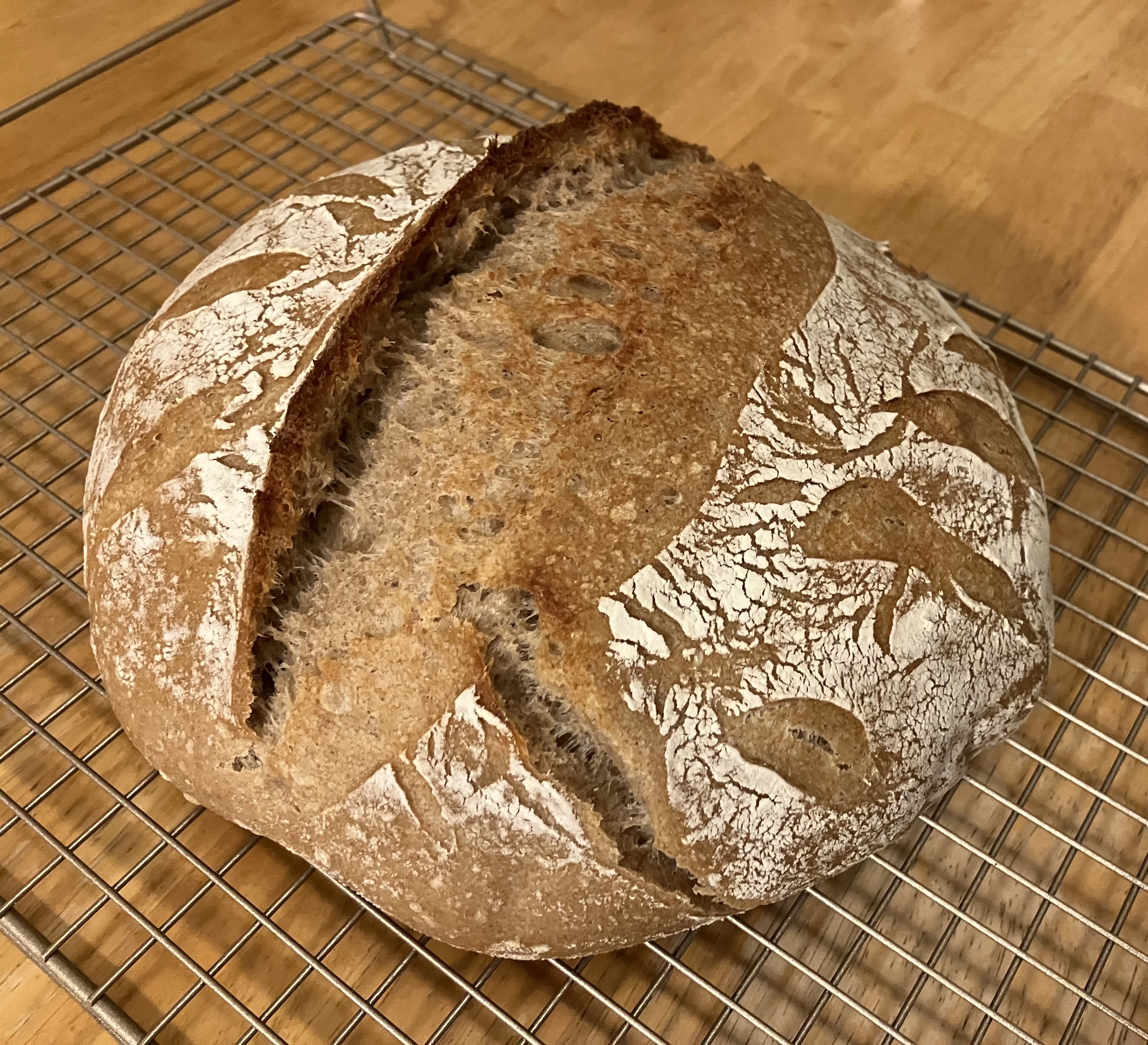
Sourdough
Ingredients
What to feed your starter:
- 100g whole wheat flour
- 25g rye flour
- 125g lukewarm filtered water
Recipe for 2 boules (round loaves):
- 686g King Arthur Organic bread flour
- 182g Bob’s Red Mill stoneground whole wheat flour
- 42g Azure Standard dark rye flour (unifine, whole grain)
- 600g + 90g lukewarm filtered water (~3 cups)
- 20g fine sea salt
- 200g active sourdough starter
Table of Contents and Timing
Procedure
1. Feed starter
Feed your starter to make sure it’s active and bubbly before beginning the bread-making process. We often feed it in the morning and by mid-day it’s ready but this can depend on temperatures, etc.
2. Autolyse
An hour before your starter reaches peak activity, make the autolyse. Combine flours and about 600g of lukewarm filtered water (reserve the remaining 90g for a later step). Mix by hand until the dough forms a ball. Cover with a damp towel and allow to sit for 1 hour.
3. Salt, water, starter, and French fold (aka slap and fold)
Ideally, at this time your starter is nice and bubbly and approximately near its peak rise. Add the sea salt and remaining water to the autolyse, then the 200g of starter (always reserve some starter for future batches). Mix with your hands - it will be messy!
Turn the dough out onto a clean surface. I like to work at hip or waist height for this part. French fold - this is optional but fun and helps the dough come together. Scoop up the dough and drop it down onto your work surface. It will be messy! Repeat until the dough begins to smooth out and become cohesive, about 5-10 minutes. You can use a dough scraper to scoop up bits of dough off your work surface as you work. Once done, return the dough to the bowl and cover with a damp towel.
Set 2 timers:
- One for 4 hours, at which point you’ll proceed with step #5
- Another for 30 minutes for the first stretch and fold
After tending to the bread dough then either feed the starter or put it in the fridge. If your house is cold you can leave it on the counter until the next morning without feeding.
4. Bulk fermentation and 3 stretch and fold sessions
This is the bulk fermentation, when you let the dough sit at room temperature. During this time, perform three sets of stretch and fold. Uncover the dough, with wet hands stretch the dough and fold it over itself 3-4 times. Cover and repeat in 30 minutes.
5. Shape loaves
Perform one final set of stretch and fold, then turn the dough out onto a floured surface. Split the dough into two even amounts. Shape each dough ball by stretching it out then pinching the ends together. Shape to create surface tension as shown in video. Let sit 10 minutes. Stretch and pinch again, then set into a banneton (bread basket) or floured bowl. Cover with a damp towel. Refrigerate overnight and bake anytime the following day.
6. Bake
Place your Dutch oven and lid inside your cold oven and preheat at 425°F for one hour. Remove one dough basket from the refrigerator. Flip dough onto parchment paper on a cutting board. Slice steam vent in dough. Carefully transfer parchment and dough to the Dutch oven. Bake, covered for 35 minutes. Remove lid then continue to bake 5-7 minutes. If making multiple loaves then preheat the empty dutch oven for 10 minutes between loaves.
Allow to cool before slicing. Once it is sliced we like to double bag each loaf and freeze them. You can pull out frozen slices of bread and toast them.